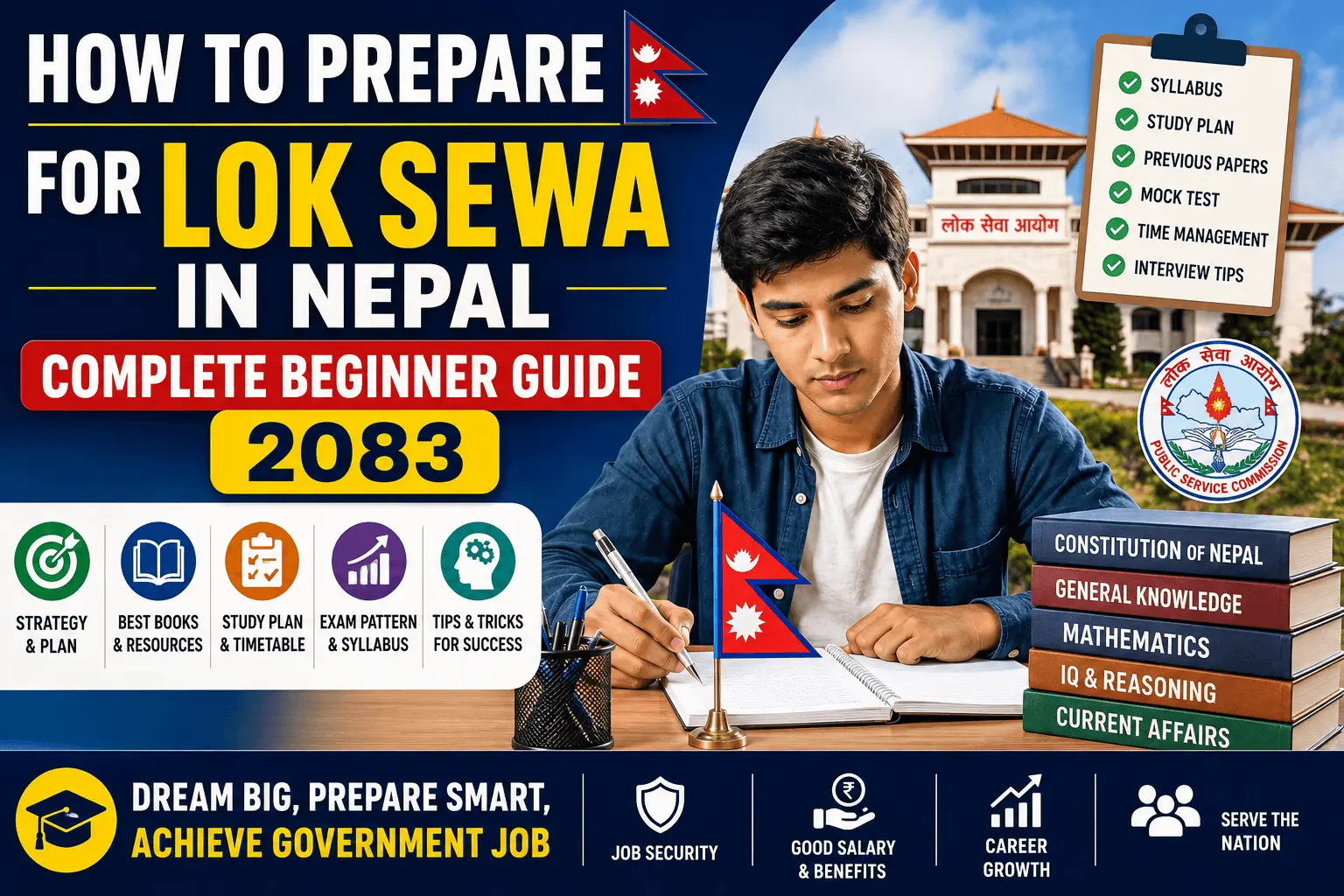
How to Prepare for Lok Sewa in Nepal: Complete Beginner Guide 2083
Every year, thousands of Nepali students and graduates dream of securing a government job through the Public Service Commission (Lok Sewa Aayog). Government jobs offer job security, attractive benefits, career growth, and the opportunity to serve the nation.
However, Lok Sewa examinations are highly competitive. Success requires a clear strategy, disciplined preparation, and consistent practice—not just long study hours. A common recommendation from experienced candidates is to begin by choosing a specific target post, studying the official syllabus, and practicing previous questions from the very beginning.
This complete beginner guide explains everything you need to know to start your Lok Sewa preparation in 2083.
What is Lok Sewa?
Lok Sewa (Public Service Commission) is the constitutional body responsible for recruiting qualified candidates for various government positions in Nepal.
Popular posts include:
- Kharidar
- Nayab Subba (NaSu)
- Section Officer
- Technical Officer
- Administrative Officer
- Health Services
- Engineering Services
- Education Services
- Provincial Public Service Commission posts
Why Choose a Government Job?
Government jobs offer several benefits:
- Job security
- Regular salary
- Pension and retirement benefits (where applicable)
- Medical and leave facilities
- Career promotion opportunities
- Social prestige
- Opportunity to contribute to national development
Step 1: Choose Your Target Post
Many beginners make the mistake of preparing without deciding which position they want.
Instead, first decide:
- Which service?
- Which level?
- Technical or non-technical?
- Federal or Provincial?
Once your target is fixed, download the official syllabus and build your study plan around it.
Step 2: Understand the Exam Pattern
Although the structure varies by post, many examinations include:
Preliminary Examination
- Multiple Choice Questions (MCQs)
- General Knowledge
- Current Affairs
- Mathematics
- IQ & Reasoning
- English
- Nepali
Main Written Examination
- Subjective Questions
- Technical Subjects (for technical posts)
- Analytical Writing
Interview
Candidates who pass the written examination are invited for the final interview.
Step 3: Download the Official Syllabus
Never study randomly.
Always download the latest syllabus for your specific post and study according to it.
The syllabus tells you:
- Topics to study
- Marks distribution
- Question pattern
- Priority areas
Step 4: Create a Study Plan
Consistency is more important than studying for very long hours.
Daily Study Schedule
Morning (2 Hours)
- General Knowledge
- Current Affairs
Afternoon (2 Hours)
- Mathematics
- IQ
- Reasoning
Evening (2–3 Hours)
- Technical Subjects
- English
- Nepali
Step 5: Study the Right Subjects
Most Lok Sewa exams include:
General Knowledge
Study:
- Nepal History
- Geography
- Constitution
- Economy
- Government Structure
- International Organizations
- Science
- Environment
Current Affairs
Read daily:
- National News
- International News
- Government Decisions
- Budget
- Economy
- Sports
- Awards
Mathematics
Practice:
- Percentage
- Profit and Loss
- Ratio
- Average
- Time and Work
- Speed
- Algebra
- Geometry
IQ & Logical Reasoning
Practice:
- Series
- Coding-Decoding
- Blood Relation
- Direction Sense
- Logical Reasoning
- Analytical Ability
English
Focus on:
- Grammar
- Vocabulary
- Comprehension
- Synonyms
- Antonyms
- Sentence Correction
Nepali
Study:
- Grammar
- Vocabulary
- Essay
- Letter Writing
- Comprehension
Step 6: Practice Previous Year Questions
One of the biggest mistakes beginners make is studying theory only.
Previous questions help you:
- Understand question patterns
- Improve speed
- Identify important topics
- Increase confidence
Many successful candidates recommend solving past papers from the first weeks of preparation rather than waiting until the end.
Step 7: Take Mock Tests
Mock tests improve:
- Time management
- Accuracy
- Confidence
- Exam temperament
Aim for at least one full mock test every week.
Step 8: Make Short Notes
Prepare concise notes for:
- Constitution Articles
- Important Dates
- Government Schemes
- International Organizations
- Scientific Facts
- Current Affairs
These notes are extremely useful during revision.
Step 9: Revise Regularly
A simple revision rule:
- Daily Revision
- Weekly Revision
- Monthly Revision
Revision helps retain information and reduces forgetting.
Best Books for Lok Sewa Preparation
Choose books based on your syllabus.
Useful resources generally include:
- Nepal Constitution
- General Knowledge books
- Current Affairs magazines
- Mathematics practice books
- IQ & Reasoning books
- Previous Year Question Collections
- Technical books (for technical services)
Best Online Resources
You can also use:
- Official vacancy notices and syllabus
- Online mock tests
- Educational YouTube channels
- Current affairs websites
- Digital flashcards
Time Management Tips
- Study every day.
- Avoid excessive social media.
- Use the Pomodoro Technique.
- Keep your phone away while studying.
- Sleep 7–8 hours.
- Exercise regularly.
Common Mistakes to Avoid
❌ Studying without reading the syllabus
❌ Collecting too many books
❌ Ignoring previous questions
❌ Skipping revision
❌ Studying irregularly
❌ Depending only on coaching classes
How Many Hours Should You Study?
There is no fixed number.
For beginners:
- 2–4 focused hours daily is a good starting point.
- Increase to 5–8 hours as the exam approaches.
Quality of study is more important than the number of hours.
90-Day Beginner Study Plan
Month 1
- Understand syllabus
- Build basic concepts
- Start current affairs
- Practice basic MCQs
Month 2
- Complete major subjects
- Solve previous papers
- Improve weak areas
Month 3
- Full revision
- Daily mock tests
- Interview preparation (if applicable)
- Improve speed and accuracy
Motivation Tips
- Stay consistent.
- Avoid comparing yourself with others.
- Track your daily progress.
- Celebrate small achievements.
- Focus on long-term goals.
Conclusion
Passing the Lok Sewa examination is possible with the right strategy and disciplined preparation. Start by selecting your target post, follow the official syllabus, practice previous questions regularly, revise consistently, and take mock tests.
Remember, success is not about studying the most hours—it is about studying the right topics consistently.
Frequently Asked Questions (FAQs)
Can beginners prepare for Lok Sewa without coaching?
Yes. Many candidates succeed through self-study if they follow the official syllabus, solve previous questions, and maintain a disciplined study schedule.
How many months are enough for preparation?
A focused preparation period of 6–12 months is common, depending on the post, your educational background, and available study time.
Is solving previous question papers important?
Yes. Previous papers help you understand the exam pattern, identify frequently tested topics, and improve time management.
How many hours should I study daily?
A consistent 2–4 hours is a good start for beginners. Increase your study time gradually as the examination approaches.
Can I prepare while studying or working?
Yes. Many successful candidates prepare alongside college or full-time jobs by following a structured daily timetable.