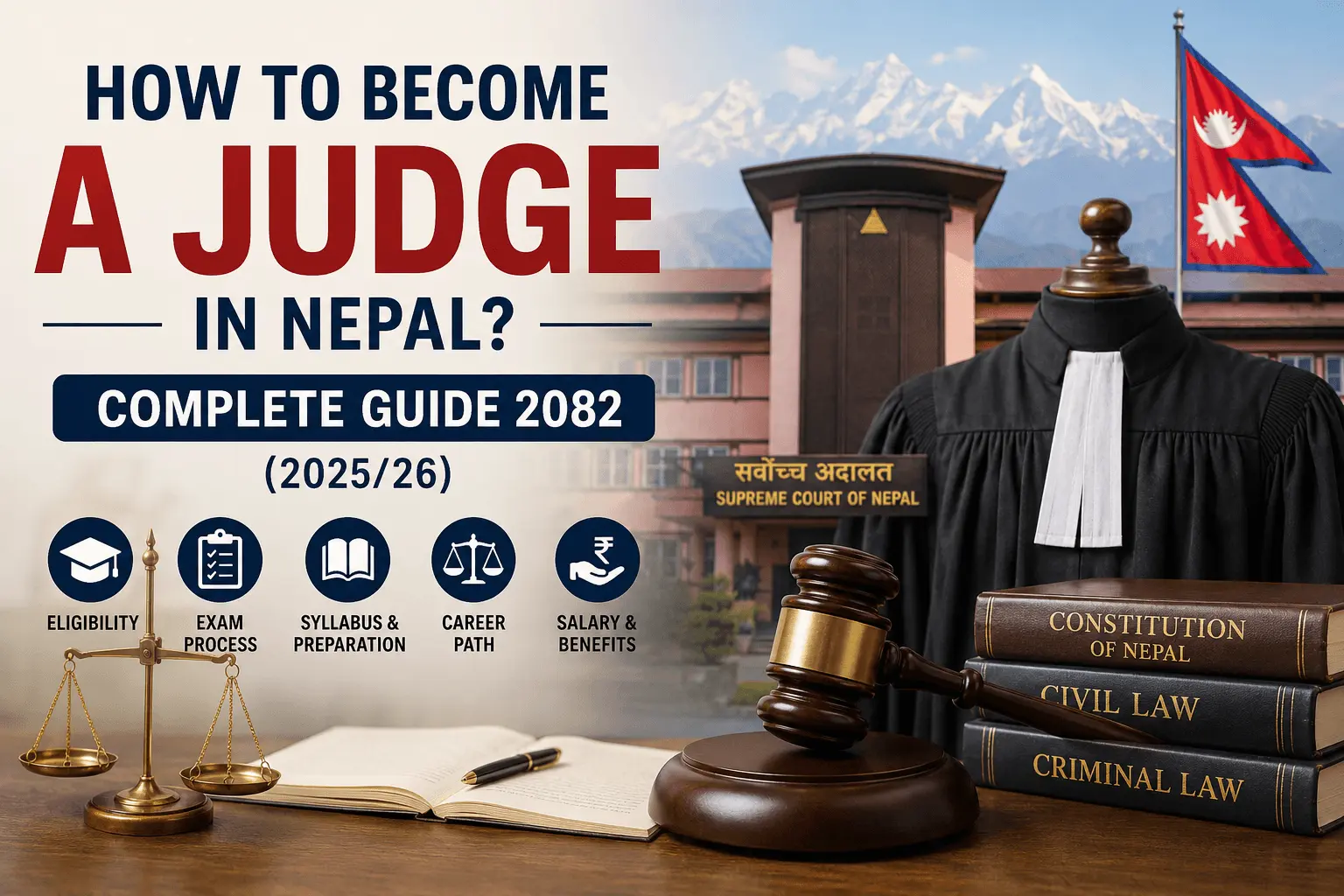
How to Become a Judge in Nepal: A Complete Guide 2026
The position of a judge in the judiciary of Nepal is considered highly honorable, responsible, and prestigious. If you are thinking of making a career in the legal field and dream of reaching a high position in the field of justice, this article is for you. Here we are providing step-by-step information on how to become a judge in Nepal, what qualifications are required, how the examination process is, what the salary is, and how the career path is.
1. Who is a Judge? Role and Importance
Judges are the backbone of the judiciary. They bear the serious responsibility of hearing cases, legal interpretation, and pronouncing impartial decisions. The Constitution of Nepal has provided special protection and authority to judges to make the judiciary independent, impartial, and transparent. A judge plays an important role in establishing peace and justice in society.
2. Basic Qualifications to Become a Judge
To become a judge under the judicial service of Nepal, the following qualifications must be met:
- Educational Qualification: Must have achieved at least a Bachelor’s degree in Law (LL.B).
- Age Limit: For District Judges, it is as prescribed by the Public Service Commission or the Judicial Service Commission. (Generally, an age limit of 21 to 35 years may apply, but it may vary according to the position.)
- Nationality: Must be a Nepali citizen.
- Experience: Differs according to the position. For example, to become a District Judge, one must have worked for at least 3 years in Gazetted Class II of the judicial service, or must have continuously practiced as a lawyer for at least 8 years.
- For High Court: Served as a District Judge for at least 5 years, or practiced law in the High Court for at least 10 years.
- For Supreme Court: Served as the Chief Judge or Judge of the High Court for at least 5 years, or an experience of at least 15 years.
3. Procedure of Judicial Service Examination (Step-by-Step)
There are two main paths to become a judge in Nepal: first, the competitive examination of the judicial service (for the District Judge) and second, the nomination of lawyers or experts in the legal field. The procedure of the competitive examination is as follows:
- Phase 1: Preliminary Examination
- Objective: To select eligible candidates for the main examination.
- Format: Multiple Choice (MCQ) questions.
- Subject: Basic knowledge of law, general knowledge, current affairs.
- Phase 2: Main Written Examination
- Format: Descriptive, problem solving, and based on case studies.
- Syllabus: Syllabus for the examination of District Judge:
- Jurisprudence, Constitutional Law, and Legal System – 100 Marks
- Civil Law and Civil Procedure – 100 Marks
- Criminal Law and Criminal Procedure – 100 Marks
- Case File Study (Case Studies) – 150 Marks (which includes judgment writing and order writing)
- Total Marks: 450 (Written) + 60 (Interview) = 510 Marks.
- Phase 3: Interview
- The candidate’s personality, legal understanding, ethics, and qualification to be a judge are checked.
- Phase 4: Appointment Recommendation
- The Judicial Service Commission prepares a list on the basis of merit and recommends it to the Judicial Council. After that, the appointment is made by the President on the recommendation of the Chief Justice.
4. Salary and Service Facilities of a Judge
The salary of a judge in Nepal is considered prestigious and attractive compared to the civil service. However, recently, judges have also expressed dissatisfaction over salary facilities【20】. Some estimated salary details are given below:
| Position of Judge | Monthly Salary (Estimated) |
| District Judge | Rs. 64,895 (Data of 2023/24) |
| High Court Judge | Rs. 76,383 (Data of 2023/24) |
| Chief Judge of HC | Rs. 80,707 (Data of 2023/24) |
| Judge of Supreme Court | Slightly more than High Court |
| Chief Justice of Supreme Court | The highest |
Note: The salary is revised by the government from time to time. All judges are also entitled to service facilities (vehicle, accommodation, security).
5. Strategy and Tips for Judicial Service Preparation
- Analyze the syllabus: Deeply understand the official syllabus of the Judicial Service Commission (JSC) or Public Service Commission (PSC).
- Practice old questions: Take time out at home to solve old question papers.
- Pay attention to case file study: Do good practice of writing decisions and orders in this paper.
- Keep information of current affairs: Especially law, human rights, and administrative developments.
- Discuss with lawyers: Interact regularly with senior lawyers to understand the actual working of the court and to increase the practice of case studies.
6. Challenges and Responsibilities
Becoming a judge of Nepal is a challenging but meaningful journey. The pressure of cases, limitation of resources, and increasing public expectations towards the role of the judiciary in recent years are its main challenges. A judge also has to face pressure to remain completely impartial and independent in their decision. But on the other hand, an incomparable opportunity is available to establish justice in society, protect rights, and strengthen the democracy of the country.
7. Conclusion
The path to becoming a judge in Nepal is difficult, competitive, and long, but it is not impossible. With concentration, continuous hard work, and right guidance, this dream can be realized. Move forward while gaining the essence of jurisprudence and detailed information of the legal system, giving priority to written practice, and understanding the heartbeat of justice of the society.
“There is never a short path in the field of justice, but every path prepares the foundation to make you a powerful and impartial judge.”
References:
- Constitution of Nepal 2072 (Article 129, 140, 149)【15】【16】【21】【23】
- Nepal Law Commission
- Judicial Service Commission【17】【19】
- The Himalayan Times【20】
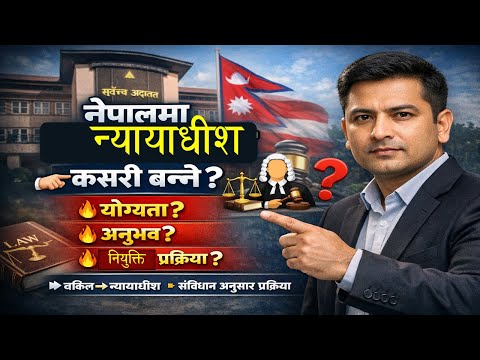
Watch: How to Become a Judge in Nepal
To better understand the judicial career path in Nepal, watch the following video: