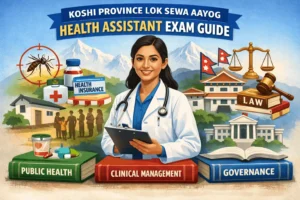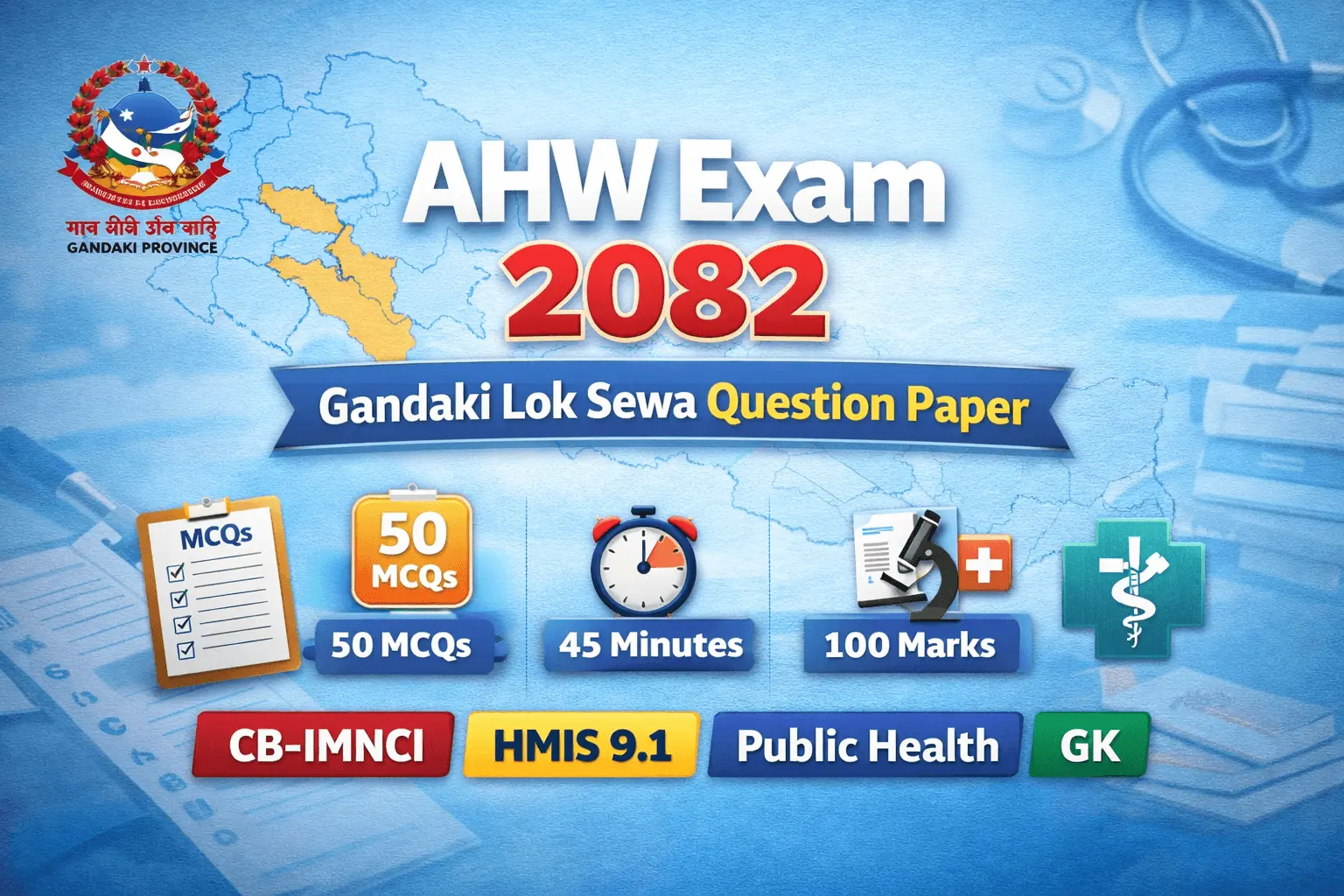
Gandaki Province Lok Sewa Aayog Health Assistant (AHW) Exam Question Paper
The Provincial Public Service Commission recently conducted the open competitive written examination for the post of Health Assistant (AHW) under the Local Health Service, Health Inspection Group, Fourth Level. The first paper was an objective multiple‑choice test held on 2082/12/28 with a duration of 45 minutes and a total of 100 marks (50 questions × 2 marks each).
This article reviews the key areas covered, highlights a few sample questions, and offers practical suggestions for candidates preparing for similar exams.
Exam at a Glance
| Detail | Information |
|---|---|
| Position | Health Assistant (AHW) – Fourth Level |
| Service / Group | Local Health Service, Health Inspection |
| Paper | First Paper (Objective) |
| Questions | 50 MCQs (A, B, C, D) |
| Total Marks | 100 (2 marks per question) |
| Time | 45 minutes |
| Date | 2082/12/28 |
Important Instructions:
- Candidates must write the answer key on the answer sheet.
- Use of calculators, mobile phones, or any electronic device is strictly prohibited.
Subject Areas Covered
The question paper tested a wide range of topics essential for a Health Assistant working at the local level in Nepal. The main domains include:
1. General Knowledge & Current Affairs (Nepal Specific)
- Age of candidates for certain positions (Q1)
- Location of endemic species in Nepal (Q2)
- Economic targets from national plans (Q3, Q4)
- UN bodies, CEDAW, Nobel Prize (Q9, Q10)
- Nepal’s representative at the UN Economic and Social Council (Q8)
2. Basic Medical Sciences & Nutrition
- Nutrients needed for growth and tissue repair (protein – Q6)
- Signs of hypothyroidism (cold intolerance, weight gain, sluggishness – Q31)
- Inflammatory signs (redness, heat, tenderness – but not itching – Q33)
- Normal pulse rate (60‑100 bpm – Q28)
3. Public Health & Disease Control
- Immunisation as primary prevention (Q25)
- Vector of dengue fever (mosquito – Q29)
- Nepal’s first public health programme (malaria eradication – Q30)
- Most common cause of maternal mortality in Nepal (postpartum haemorrhage – Q42)
- Communicable disease among options (trachoma – Q46)
- Causative agent of malaria (protozoa – Q45)
- Neurocysticercosis caused by (pork tapeworm – Q47)
4. Clinical Assessment & IMNCI
- Provisional diagnosis after history & examination (Q32)
- Classification of a 2‑year‑old with fast breathing but no chest indrawing – according to CB‑IMNCI (pneumonia – Q43)
- Classification of a 9‑month‑old with respiratory rate 42/min (pneumonia – Q48)
5. Health Programmes & Policies
- Current National Health Policy of Nepal (formulated in 2076 BS – Q38)
- National guideline on integrated vector management (effective 2019 AD – Q41)
- EWARS for infectious disease reporting in Nepal (Q40)
- HMIS tool for monthly reporting from Health Post to Local Level (HMIS 9.1 – Q39)
6. Pharmacy & Logistics
- FEFO principle (First Expiry, First Out – Q36)
- Antibiotic among options (metronidazole – Q35)
7. Basic Procedures & Definitions
- Liquid waste mixed with excreta (sewage – Q26)
- Shock due to profuse blood loss (hypovolaemic shock – Q27)
- Closed fracture – bone fragment not protruding (Q34)
- Collection of fluid between pleura (pleural effusion – Q50)
8. Behavioural & Social Aspects
- Negative belief that leprosy is caused by God’s wrath (stigma – Q37)
9. Technology & Miscellaneous
- Internet of Things (connecting everyday physical objects to the internet – Q5)
Sample Questions (with correct answers)
| Q.No. | Question | Correct Option |
|---|---|---|
| 6 | शरीरको वृद्धि विकास र तन्तुहरुको मर्मतका लागि कुन पोषक तत्व आवश्यक पर्छ ? | A. प्रोटिन |
| 28 | What is the normal pulse? | B. 60‑100 bpm |
| 30 | Nepal’s first public health program is: | C. Malaria eradication program |
| 36 | In pharmacy inventory management, what does the ‘FEFO’ principle stand for? | C. First expiry, first out |
| 39 | Which HMIS tool is specifically used for the ‘Monthly Reporting’ from a Health Post to the Local Level? | D. HMIS 9.1 |
| 43 | A 2‑year‑old child has cough and fast breathing (>40/min) but no chest indrawing. According to CB‑IMNCI, how should this be classified? | D. Pneumonia |
| 50 | The collection of fluid in between the pleura is known as: | D. Pleural effusion |
Key Takeaways for Aspirants
- Know Nepal’s health priorities
Questions on the National Health Policy, malaria eradication, and vector management appear frequently. Memorise the key years (2076 BS for policy, 2019 AD for IVM). - Master basic clinical classifications
IMNCI (CB‑IMNCI) is a favourite topic. Understand the difference between “pneumonia” and “severe pneumonia” based on chest indrawing and danger signs. - Revise common diseases
Dengue (vector), malaria (protozoa), neurocysticercosis (pork tapeworm), and leprosy (stigma) are must‑know. - Don’t ignore HMIS & logistics
Tools like HMIS 9.1 and principles like FEFO are simple marks if you have prepared them. - Current affairs – national & international
Nepal’s representation at the UN, CEDAW year (1979), and Nobel Prize categories (6) are quick wins. - Time management
With only 45 minutes for 50 questions, you have less than one minute per question. Practise solving MCQs under timed conditions.
Final Words
This question paper reflects the realistic expectations from a Health Assistant working in Nepal’s local health system. It balances clinical knowledge, public health programmes, national policies, and basic management skills. Candidates who systematically study the CB‑IMNCI guidelines, the National Health Policy, and the core subjects of community medicine will find the exam manageable.
If you are preparing for a similar position, use this breakdown as a checklist. Focus on high‑yield areas: maternal/child health, communicable diseases, HMIS, and Nepal’s health history.
Good luck to all future Health Assistants serving the communities of Nepal!


Koshi Province Health Assistant Exam Question Paper: A Complete Breakd
Lok Sewa Aayog Computer Operator Questions 2082 PDF | PSC Past Papers & Notes
PSC Engineering 7th Level Exam Syllabus Madhesh Pradesh