NEB Class 12 Physics (Technical Stream) Model Question 2082-83 with Solutions
The NEB Class 12 Physics (Technical Stream) Model Question 2082/83 with Solutions has been prepared for students who are appearing in the NEB board examination of the year 2082 (2026). These model questions help students understand the structure of the board exam, question pattern, and important topics included in the syllabus.
According to the NEB Class 12 exam routine, the Physics (Technical Stream) examination will be conducted on Baisakh 17, 2083. Therefore, students are strongly encouraged to practice these model questions regularly. Solving model question papers helps students analyze the exam pattern, improve time management skills, and strengthen their understanding of physics concepts.
Class 12 Physics (Technical Stream) Model Question 2082/83
The Class 12 Physics (Technical Stream) Model Question 2082/83 provided below includes the actual questions from the board examination 2082. Because of this, it serves as an excellent reference and practice material for students preparing for the NEB Class 12 Board Exam 2083.
Students are advised to solve the model questions carefully and review the answers provided. Regular practice of these questions will help students perform better and achieve higher marks in the board exam.

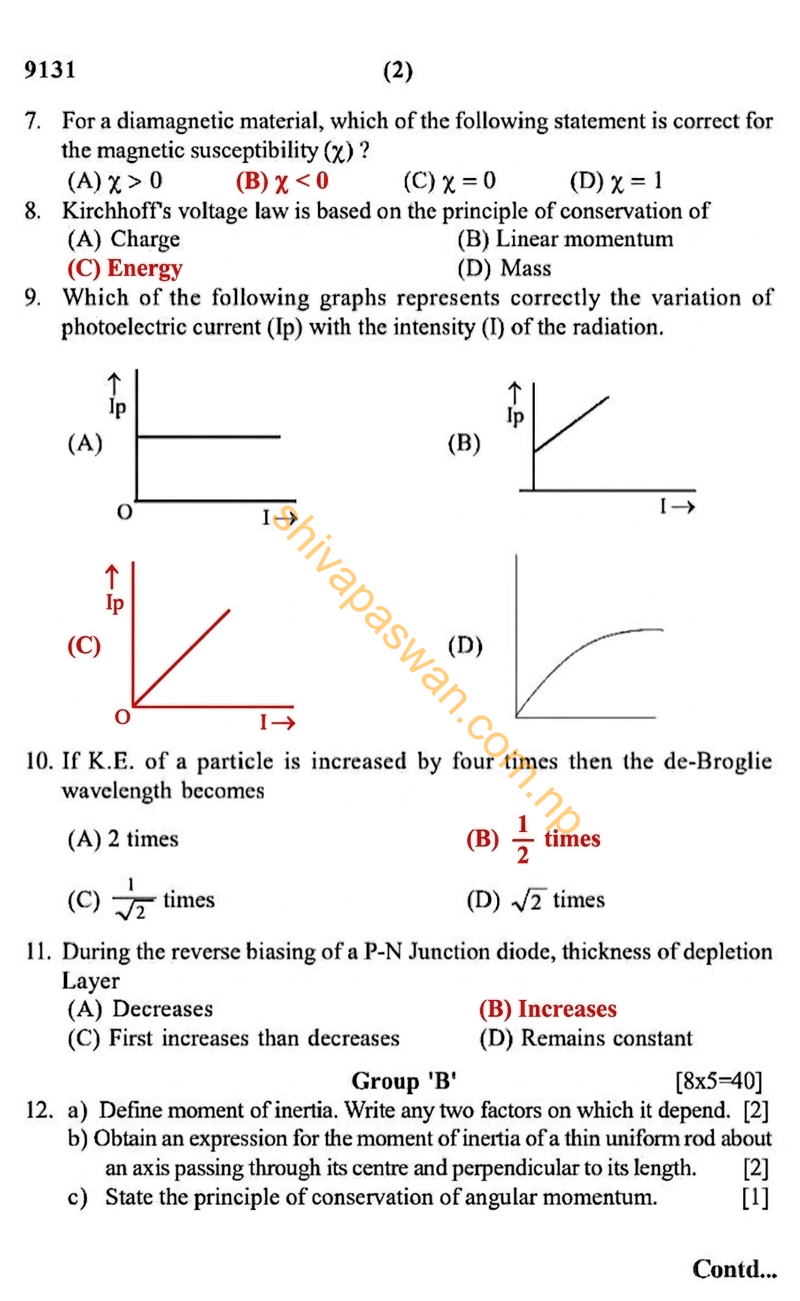
Group ‘B’ – 8×5=40
12. a) Moment of inertia
Moment of inertia is the rotational analogue of mass, defined as for discrete particles, or I for continuous bodies. It depends on:
- The mass of the body
- The distribution of mass about the axis of rotation
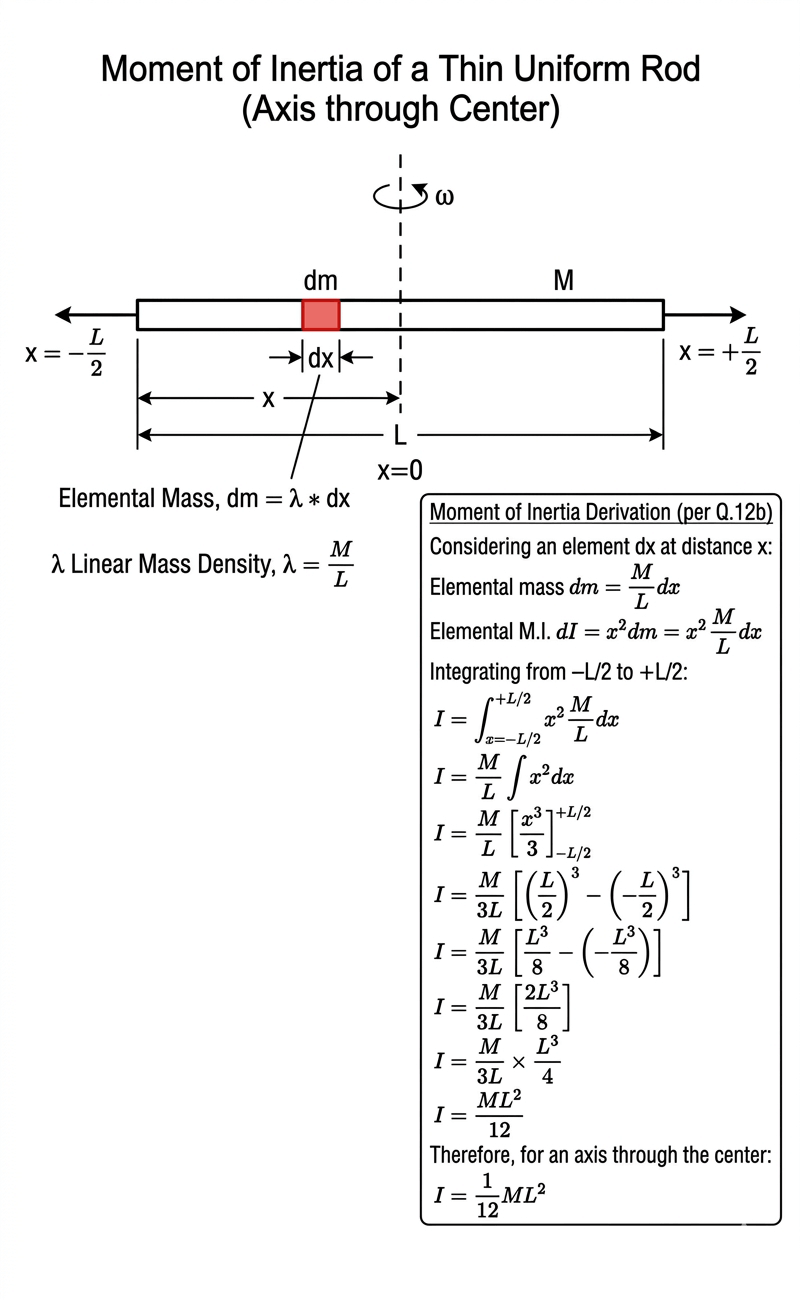
b) Moment of inertia of a thin uniform rod
Consider a rod of length and mass , axis through its centre perpendicular to length. Take an element at distance from centre. Mass per unit length .
c) Principle of conservation of angular momentum
If no external torque acts on a system, its total angular momentum remains constant.
13. a) Surface tension
Surface tension is the force per unit length acting in the plane of the liquid surface, perpendicular to an imaginary line drawn on the surface.
b) Surface tension equals surface energy
Consider a rectangular film of length l and width , with one movable side. To increase the area by , work done (factor 2 because film has two surfaces). This work is stored as surface energy. Hence surface energy per unit area.
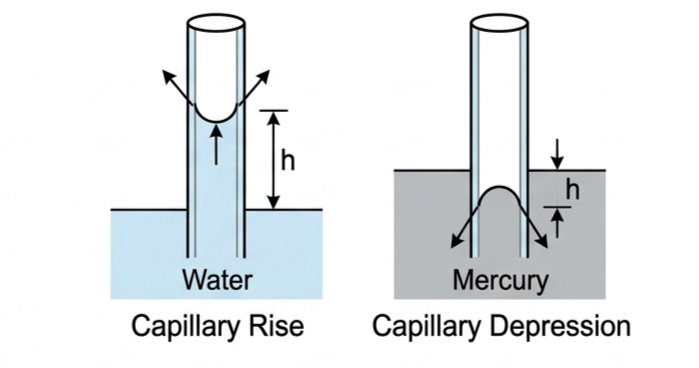
c) Capillarity
Capillarity is the rise or fall of a liquid in a narrow tube due to surface tension.
Examples:
- Rise of water in a glass capillary tube
- Depression of mercury in a glass tube
Example:
14. a) Laplace correction
Newton assumed sound propagation is isothermal, giving . Laplace corrected that compressions and rarefactions occur rapidly, so the process is adiabatic. The bulk modulus becomes , giving
b) Temperature for 50% increase in speed
Speed of sound . Let . Then
Given , .
15. a) Harmonics
Harmonics are the integral multiples of the fundamental frequency.
b) Modes of vibration in an open organ pipe
For an open pipe of length , both ends are displacement antinodes. The allowed frequencies areExample:
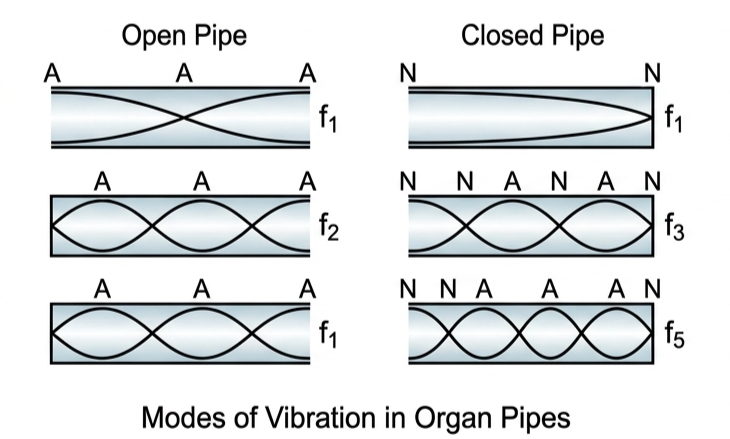
All harmonics are present. The first mode () is the fundamental, first overtone, etc.
c) End correction
Due to the air just outside the pipe, the effective length is slightly longer than the geometric length. The correction (where is radius) is added to both ends for an open pipe, and to one end for a closed pipe.
16. a) Diffraction of light
Diffraction is the bending of light waves around obstacles or through apertures, causing spreading of light into the geometrical shadow.
b) Necessary condition
The size of the obstacle/aperture should be comparable to the wavelength of light.
c) i) Coherent sources
Two sources are coherent if they have a constant phase difference (usually same frequency and fixed phase relation).
ii) Conditions for interference
- Constructive: path difference (n = 0,1,2,…)
- Destructive: path difference
17. a) Principle of potentiometer
The potential drop across a uniform wire is directly proportional to its length, provided the current is constant.
b) Why potentiometer is preferred
A voltmeter draws some current from the cell, so the measured terminal voltage is less than the emf. A potentiometer measures the emf by balancing without drawing any current, giving the true emf.
c) Kirchhoff’s laws
- Junction law: The algebraic sum of currents meeting at a junction is zero (conservation of charge).
- Loop law: The algebraic sum of potential changes around any closed loop is zero (conservation of energy).
OR
a) Biot–Savart law
The magnetic field due to a current element at a point is
b) Magnetic field at centre of a circular coil
For a circular loop of radius carrying current , each element dl contributes (since ). All contributions are perpendicular to the plane. Integrating gives
18. a) Conversion of galvanometer to ammeter
A low resistance (shunt) is connected in parallel with the galvanometer. The shunt diverts most of the current, allowing the galvanometer to measure larger currents.
b) Ammeter connection
An ammeter must be connected in series so that the entire current to be measured flows through it. Its resistance is kept very low to minimise voltage drop.
19. a) Einstein’s photoelectric equation
where is the photon energy, is the work function. Threshold frequency is the minimum frequency that can cause emission, given by .
b) Calculation
Photon energy , work function
OR
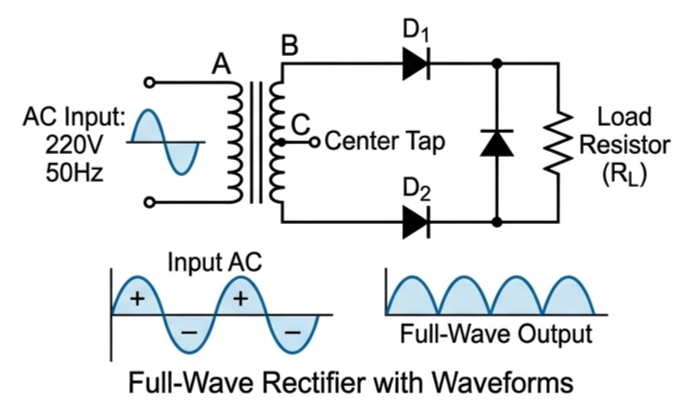
a) Rectifier
A device that converts alternating current (AC) into direct current (DC).
b) Full wave rectifier using two diodes
Two diodes are connected to a centre‑tapped transformer. During positive half‑cycle, one diode conducts; during negative half‑cycle, the other conducts. Both half‑cycles produce current in the same direction through the load.
c) Waveforms
Input: sinusoidal AC. Output: pulsating DC (both half‑cycles positive). A filter capacitor smoothens the output.
Exmaple:
Group ‘C’ – 3×8=24
20. a) Simple harmonic motion (SHM)
Oscillatory motion in which the restoring force is directly proportional to the displacement from mean position and always directed towards it.
b) Acceleration from given equation
. For a particle at fixed , velocity . Acceleration
c) Spring‑mass system
For a mass attached to a spring of force constant , the restoring force is (Hooke’s law). By Newton’s second law,
This is the SHM equation with . Hence the motion is SHM.
d) Numerical
Mass , amplitude , maximum force .
For SHM, ⇒ ⇒
Maximum velocity
21. a) RMS value of AC
It is the steady DC value that would produce the same average power dissipation in a resistor as the AC.
b) Relation with peak value
For sinusoidal AC, , .
c) Pure inductor
Let . The voltage across inductor . Hence voltage leads current by (or current lags voltage by π).
Phasor diagram: Draw current phasor along horizontal; voltage phasor along vertical (90° ahead).
d) LCR circuit calculation
Given: , , , , .
22. a) Cross field
When electric and magnetic fields are mutually perpendicular, they form a cross field.
b) Motion of electron in magnetic field
An electron moving with velocity perpendicular to a uniform magnetic field experiences a force , which is perpendicular to , providing centripetal force. Hence the path is circular.
Time period (independent of speed).
c) Comparison of radii
For same speed v and same B, . Electron and proton have equal magnitude of charge (), but . Hence . The proton’s radius is about 1836 times larger.
d) Water drop suspended in electric field
Charge , . For equilibrium, .
Mass
Density of water , volume
OR
a) Ionization potential
The minimum accelerating potential required to remove an electron from an atom, equal to the ionization energy divided by e.
b) Visible spectral series of hydrogen
Balmer series lies in the visible region. Longest wavelength corresponds to transition from to .
c) Controlling quality of X‑rays
The quality (penetrating power) of X‑rays is controlled by the accelerating voltage (kV) applied to the X‑ray tube. Higher voltage produces harder (shorter wavelength) X‑rays. The intensity is controlled by the tube current (mA).
d) de Broglie wavelength of X‑rays with KE = 200 eV
For electrons, .
NEB Class 12 Model Questions 2082/2083 – All Subjects PDF Download
Students looking for more practice materials can also download NEB Class 12 Model Questions 2082/2083 for all subjects in PDF format. Practicing multiple model papers will help students become more familiar with the exam pattern and frequently asked questions.