The Province Public Service Commission (PSC), Province No. 2 has announced the competitive examination for the post of Gazetted Class III (7th Level), Nepal Engineering Service – Civil Group, Building and Architect Subgroup. This blog post is a complete preparation guide for aspiring engineers aiming to secure a government position under this category.
In this article, you will find the entire syllabus, exam structure, and important subject outlines based on the official curriculum. We have also included model questions and answer formats to help candidates prepare effectively for both papers. Paper I covers General Awareness and General Ability, while Paper II focuses on Technical Subjects such as Structural Engineering, Engineering Survey, Construction Materials, Concrete Technology, Geotechnical Engineering, Estimating & Costing, and more.
The content is carefully compiled based on the official PSC syllabus to assist students in understanding the exam format and required topics. Whether you are a first-time candidate or repeating the exam, this blog provides valuable resources to help you organize your study and improve your chances of success.
If you are targeting a government engineering job in Province 2, this guide can be your go-to preparation companion.
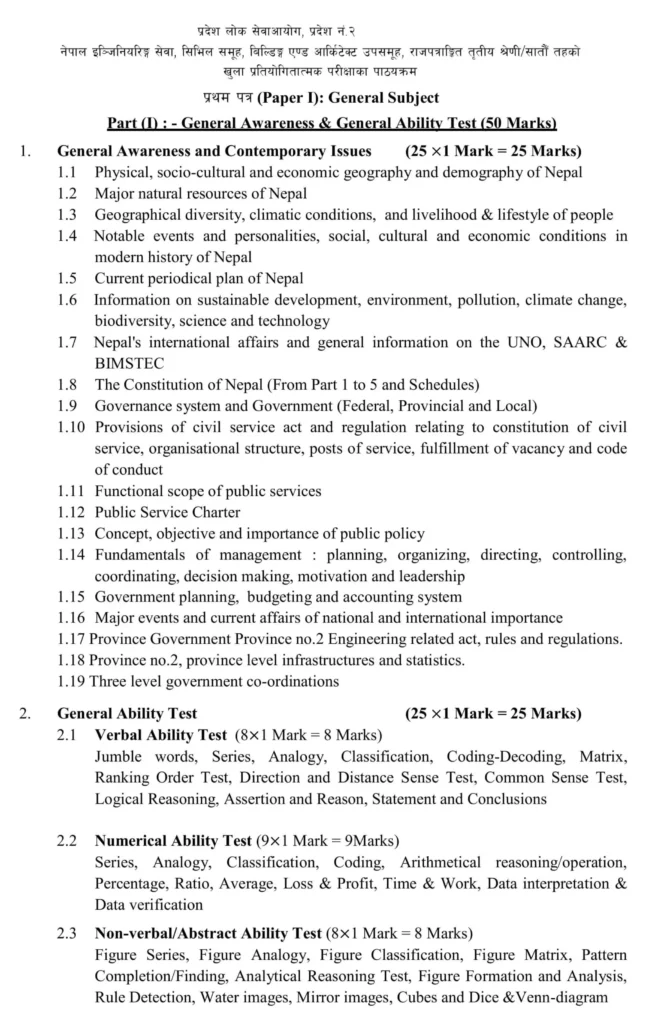
1. General Awareness and Contemporary Issues (25 x 1 = 25 Marks)
1.1 Physical, Socio-Cultural and Economic Geography and Demography of Nepal
Nepal is divided into Mountain, Hill, and Terai regions. It is home to diverse ethnic groups, languages, and religions. Agriculture, tourism, and remittance are major economic activities. Population: ~29.16 million (2078 census).
1.2 Major Natural Resources of Nepal
Water, forest, minerals, biodiversity, and agricultural land are Nepal’s key resources.
1.3 Geographical Diversity, Climate, and Lifestyle
Nepal has a wide range of altitudes, resulting in varied climates: alpine, temperate, and tropical. People follow diverse livelihoods based on region.
1.4 Notable Events and Personalities in Modern History
Major events: Sugauli Treaty, 1951 Democracy, 1990 People’s Movement, 2006 Revolution. Notable personalities: Prithvi Narayan Shah, BP Koirala.
1.5 Current Periodic Plan of Nepal
Nepal is implementing the 15th Five-Year Plan (FY 2076/77–2080/81).
1.6 Sustainable Development and Environment
Focus on SDGs, pollution control, climate change mitigation, biodiversity conservation, and sustainable use of resources.
1.7 Nepal’s International Affairs (UNO, SAARC, BIMSTEC)
Nepal is a founding member of SAARC and active in UNO and BIMSTEC. Advocates peace and development.
1.8 Constitution of Nepal (Part 1 to 5 and Schedules)
Covers state structure, citizenship, fundamental rights, directive principles, duties, and governmental organs.
1.9 Governance System (Federal, Provincial, Local)
Nepal follows federal governance with 3 tiers: federal, 7 provinces, and 753 local levels.
1.10 Civil Service Act & Regulations
Defines structure, recruitment, duties, posts, promotions, and code of conduct for civil servants.
1.11 Functional Scope of Public Services
To provide services, implement laws, maintain good governance, and support development activities.
1.12 Public Service Charter
A commitment by public offices to deliver quality services within a timeframe.
1.13 Concept, Objective, and Importance of Public Policy
Guides national priorities and decision-making. Objectives: development, justice, and good governance.
1.14 Fundamentals of Management
Includes planning, organizing, directing, coordinating, decision-making, motivation, and leadership.
1.15 Government Planning, Budgeting, and Accounting System
Annual budget process involves planning, resource allocation, expenditure tracking, and auditing.
1.16 Major National and International Current Affairs
Examples: COVID-19 recovery, federal elections, G20 summits, COP climate conferences.
1.17 Province No. 2 Engineering Related Acts and Rules
Includes building codes, provincial laws, public procurement and infrastructure regulations.
1.18 Province No. 2 Infrastructures and Statistics
Key infrastructure: roads, irrigation, buildings, energy. Data used for planning and development.
1.19 Three-Level Government Coordination
Collaboration among federal, provincial, and local levels ensures effective service delivery.
2. General Ability Test (25 x 1 = 25 Marks)
2.1 Verbal Ability Test (8×1 Mark = 8 Marks)
Topics: Jumble words, Series, Analogy, Classification, Coding-Decoding, Matrix, Ranking Order Test, Direction and Distance Sense Test, Common Sense Test, Logical Reasoning, Assertion and Reason, Statement and Conclusions
2.2 Numerical Ability Test (9×1 Mark = 9Marks)
Topics: Series, Analogy, Classification, Coding, Arithmetical reasoning/operation, Percentage, Ratio, Average, Loss & Profit, Time & Work, Data interpretation & Data verification
2.3 Non-verbal/Abstract Ability Test (8×1 Mark = 8 Marks)
Topics: Figure Series, Figure Analogy, Figure Classification, Figure Matrix, Pattern Completion/Finding, Analytical Reasoning Test, Figure Formation and Analysis, Rule Detection, Water images, Mirror images, Cubes and Dice & Venn-diagram
2.1 Verbal Ability Test (8 x 1 = 8 Marks)
Topics Covered: Jumble words, Series, Analogy, Classification, Coding-Decoding, Matrix, Ranking Order Test, Direction and Distance Sense Test, Common Sense Test, Logical Reasoning, Assertion and Reason, Statement and Conclusions
Q1. Find the odd word: Apple, Banana, Mango, Carrot
Ans: Carrot
Q2. Arrange alphabetically: Zebra, Mango, Apple, Banana
Ans: Apple, Banana, Mango, Zebra
Q3. Jumbled Sentence: “is / Kathmandu / capital / the / of / Nepal”
Ans: Kathmandu is the capital of Nepal.
Q4. Analogy: Dog : Bark :: Cat : ?
Ans: Meow
Q5. Series: 2, 4, 8, 16, ?
Ans: 32
Q6. Direction: If you walk north then turn right, what direction is that?
Ans: East
Q7. Coding-Decoding: If CAT = DBU, then DOG = ?
Ans: EPH
Q8. Statement & Conclusion: All apples are fruits. All fruits are healthy. Conclusion: Apples are healthy.
Ans: True
2.2 Numerical Ability Test (9 x 1 = 9 Marks)
Q1. 25% of 200 = ?
Ans: 50
Q2. Profit: Cost = Rs.100, Selling = Rs.120
Ans: Profit = Rs.20 (20%)
Q3. Average of 2, 4, 6, 8, 10
Ans: 6
Q4. Ratio of 2:3 expressed as fraction
Ans: 2/3
Q5. If 5 workers take 10 days, how long will 10 workers take?
Ans: 5 days
Q6. Coding: If A=1, B=2,… Z=26, then SUM = ?
Ans: S(19) + U(21) + M(13) = 53
Q7. Percentage change from 100 to 120
Ans: 20%
Q8. Data Interpretation: If a bar chart shows sales increase from 100 to 150 units, what is the % increase?
Ans: 50%
Q9. Simple Interest: P=1000, R=5%, T=2 yrs
Ans: SI = (1000x5x2)/100 = Rs.100
2.3 Non-verbal / Abstract Ability Test (8 x 1 = 8 Marks)
Q1. Find the next figure in pattern: □ ○ □ ○ ?
Ans: □
Q2. Mirror image of letter “K”
Ans: Left-facing “K”
Q3. Odd figure out from 4 shape options
Ans: The one not matching symmetry
Q4. Cube with numbers, what is opposite of 6 if 1 is adjacent to it?
Ans: 3 (Example only)
Q5. Complete the pattern: Triangle, Square, Triangle, ?
Ans: Square
Q6. Venn diagram: Fruits, Apples, Red items. Apple belongs to all three.
Q7. Water image of word “DOG”
Ans: Appears vertically reversed
Q8. Figure series: Rotating arrow in circle by 90 degrees each time, what comes next?
Ans: Arrow pointing opposite to previous
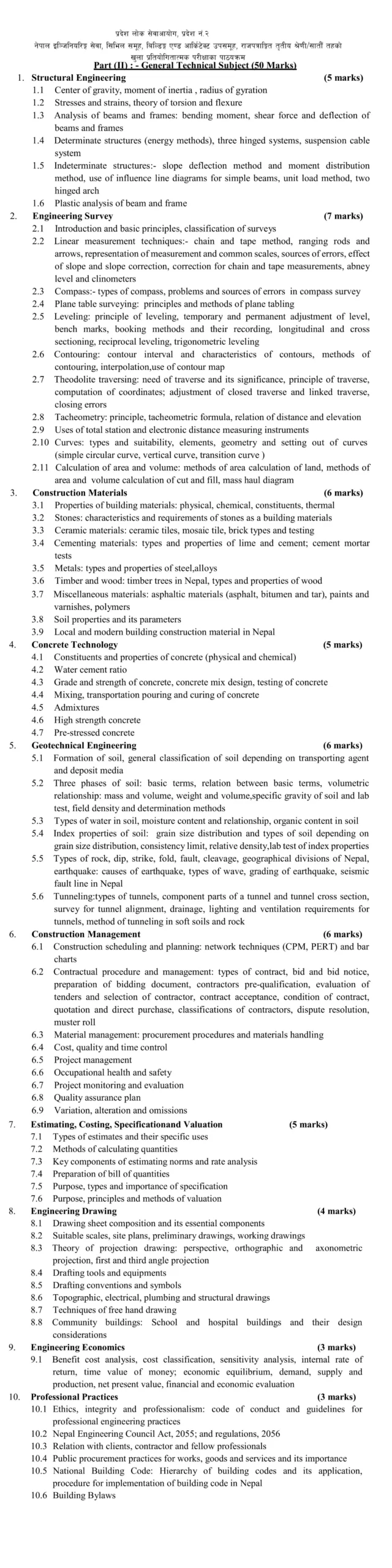
Part (II): General Technical Subject (50 Marks)
1. Structural Engineering (5 Marks)
- Center of gravity is the point at which the whole weight of a body appears to act.
- Moment of inertia measures an object’s resistance to rotational motion.
- Radius of gyration is the distance from the axis of rotation where the mass of the body can be assumed to be concentrated.
- Stresses and strains are internal resistance and deformation due to external load.
- Theory of torsion and flexure helps in analyzing shaft and beam under load.
- Bending moment and shear force are calculated in beams and frames.
- Energy methods are used for determinate structures. Slope deflection and moment distribution methods for indeterminate ones.
- Plastic analysis deals with limit state of beams and frames.
2. Engineering Survey (7 Marks)
- Covers principles and classification: plane, geodetic surveys.
- Chain and tape, compass, leveling, and plane table methods are traditional tools.
- Total station and EDM (Electronic Distance Measurement) are modern tools.
- Theodolite used in angular measurements and traversing.
- Contouring and tacheometry are important in elevation and mapping.
- Curves (horizontal and vertical) are used in road/railway design.
- Mass haul diagram used for earthwork estimation.
3. Construction Materials (6 Marks)
- Building materials include stone, brick, cement, lime, steel, wood, polymers.
- Characteristics include physical (density, texture), chemical, and thermal properties.
- Tests: compressive strength (brick, concrete), fineness and setting time (cement).
- Asphalt, tar, bitumen used in roadwork.
- Timber properties and species like Sal, Sissoo used in Nepal.
4. Concrete Technology (5 Marks)
- Concrete made of cement, sand, aggregates, and water.
- Water-cement ratio influences strength.
- Mix design helps target strength.
- High strength concrete and admixtures improve performance.
- Curing is essential for gaining strength.
5. Geotechnical Engineering (6 Marks)
- Soil classified by origin: alluvial, colluvial, glacial.
- Soil properties: grain size, Atterberg limits, density, specific gravity.
- Rocks: dip, strike, fold, fault. Nepal is seismically active.
- Tunnels need drainage, ventilation, lighting and stable cross-section.
6. Construction Management (6 Marks)
- Planning and scheduling tools: CPM, PERT, bar charts.
- Contract types: item rate, lump sum, EPC.
- Tendering process includes bidding, evaluation, award.
- Health and safety, cost control, quality assurance are vital.
7. Estimating, Costing, Specification and Valuation (5 Marks)
- Types of estimates: preliminary, detailed.
- BOQ includes quantity and cost breakdown.
- Specification ensures material and work quality.
- Valuation assesses property value based on cost, market.
8. Engineering Drawing (4 Marks)
- Orthographic, isometric, perspective projections are used.
- Scales, symbols, and conventions are essential.
- Structural, plumbing, electrical drawings are included.
- Community building layouts must consider function and safety.
9. Engineering Economics (3 Marks)
- Covers cost-benefit analysis, NPV, IRR, payback.
- Concepts of demand, supply, and economic equilibrium.
- Financial vs. economic evaluation.
10. Professional Practices (3 Marks)
- Includes ethics, professionalism, code of conduct.
- NEC Act 2055 and regulations govern engineers.
- Public procurement, building codes, and bylaws must be followed.